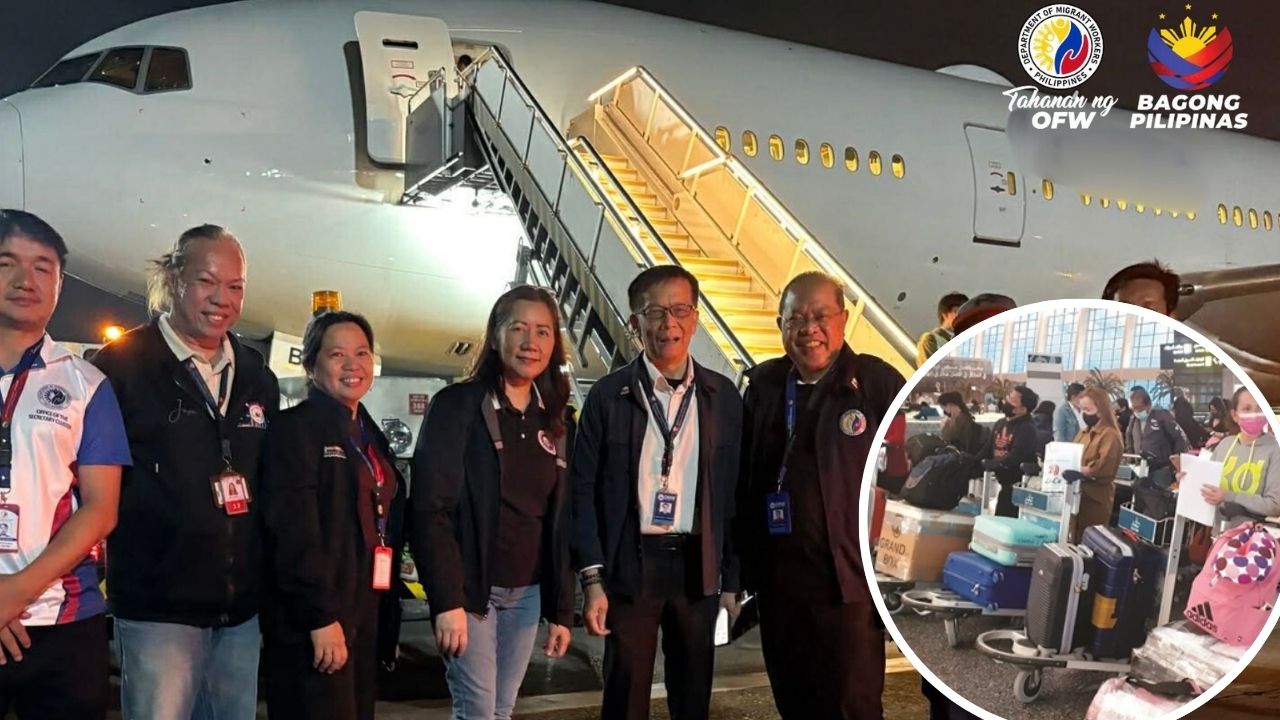
PHILIPPINES: The government has deployed its third chartered repatriation flight to assist Overseas Filipino Workers (OFWs) affected by ongoing tensions in the Middle East, as part of a sustained humanitarian airlift now referred to as “Air DMW.”
The flight left Manila Wednesday early morning, carrying Department of Migrant Workers (DMW) Undersecretary Dominique Rubia-Tutay and Assistant Secretary Venecio Legaspi, who will oversee the safe return of Filipinos opting to come home.
Contents
“Air DMW” repatriation flights to continue
Malacañang confirmed that repatriation operations will remain active as long as needed.
“The instructions of the President are clear: to keep the humanitarian airlift going,” Executive Secretary Ralph Recto said, referring to the ongoing deployment of government-arranged flights.
This “Air DMW” initiative, led by DMW Secretary Hans Leo J. Cacdac, is part of a broader effort to respond quickly to the needs of Filipinos in conflict-affected areas.
Officials sent to assist OFWs on the ground
Rubia-Tutay and Legaspi were tasked to personally assist OFWs abroad, ensuring a smooth and secure evacuation process.
Their responsibilities include:
-
Coordinating with embassies and local authorities
-
Assisting with travel documents and clearances
-
Supporting OFWs from departure to arrival in the Philippines
Cacdac directed both officials to prioritize safety and order throughout the repatriation process, following the directive of President Ferdinand R. Marcos Jr.
Over 1,700 OFWs already home
Since March 5, more than 1,700 OFWs and their dependents have been brought back to the Philippines through the government’s whole-of-government response.
Recent data shows that 125 OFWs and their dependents safely returned on March 17 alone, arriving via five separate flights arranged under the program.
Authorities say more flights will continue in the coming days as demand increases.
Why repatriation efforts are expanding
The continued deployment of chartered flights reflects the growing number of Filipinos seeking assistance as tensions in parts of the Middle East persist.
Many OFWs, especially those in high-risk areas, are choosing voluntary repatriation for safety and stability.
With uncertainty still high, the government is scaling up its response to ensure faster and more organized evacuations.
What OFWs should watch next
For OFWs in affected countries, repatriation remains ongoing and accessible.
Those considering returning are advised to stay in contact with Philippine embassies or Migrant Workers Offices for updates on flight schedules and eligibility.
As the situation develops, more “Air DMW” flights are expected to be deployed—reinforcing the government’s commitment to bring Filipinos home safely.